

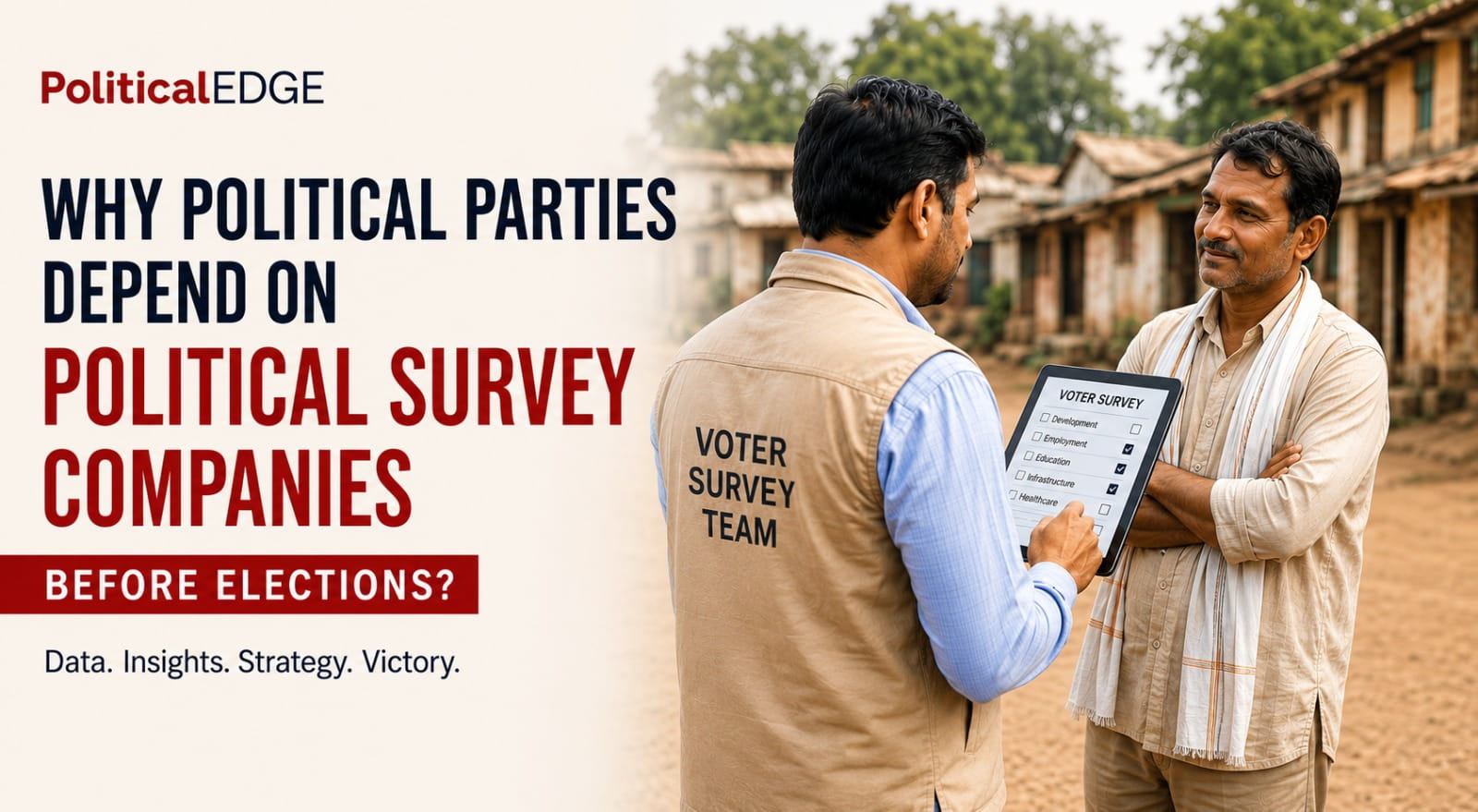
Why Political Parties Depend on Political Survey Companies Before Elections
Political parties depend on political survey companies before elections because they provide data-driven insights into voter behavior, public sentiment, candidate popularity, key issues, and constituency-level trends. Surveys help political parties make informed decisions about candidate selection, campaign messaging, resource allocation, and voter outreach strategies. In today’s competitive electoral environment, relying solely on assumptions can be risky, making professional political surveys a critical part of election planning and campaign management.
Key Takeaways
- Political surveys help parties understand voter sentiment.
- Survey data supports smarter candidate selection.
- Political research identifies key voter issues and concerns.
- Booth-level analysis improves campaign efficiency.
- Surveys help optimize campaign budgets and resources.
- Data-driven campaigns outperform assumption-based strategies.
- Political survey companies provide actionable electoral intelligence.
- Real-time voter feedback helps parties adapt quickly.
Introduction
Winning an election requires much more than rallies, speeches, and political advertisements. Modern elections are increasingly driven by data, voter insights, and strategic decision-making. Political parties today operate in a highly competitive environment where understanding voter behavior can make the difference between victory and defeat.
This is where political survey companies play a crucial role.
Political survey companies help parties move beyond assumptions by providing evidence-based insights into what voters think, what issues matter most to them, and how candidates are perceived within their constituencies.
As elections become more sophisticated and voter expectations continue to evolve, political surveys have become an essential component of successful election campaign management.
Understanding the Role of Political Survey Companies
Political survey companies specialize in collecting, analyzing, and interpreting voter data.
Their objective is to provide political parties with accurate information about:
- Voter preferences
- Candidate popularity
- Public sentiment
- Local issues
- Community concerns
- Electoral trends
- Opposition strengths and weaknesses
Rather than relying on anecdotal feedback, political leaders gain access to structured data that supports strategic planning.
Why This Matters
Political decisions based on assumptions can result in ineffective campaigns, poor candidate choices, and wasted resources. Survey-driven insights reduce uncertainty and improve decision-making.
Understanding Voter Sentiment Before Elections
One of the primary reasons parties hire political survey companies is to understand voter sentiment.
Voters often have concerns that are not visible through public events or social media conversations. Professional surveys help uncover these hidden perceptions.
What Voter Sentiment Analysis Reveals
- Government approval ratings
- Satisfaction with elected representatives
- Key voter concerns
- Community priorities
- Public perception of political parties
Impact on Elections
Parties can adjust their campaign strategies based on actual voter expectations rather than assumptions.
Strategic Implications
Understanding sentiment early allows political parties to address concerns before they become major electoral challenges.
Selecting the Right Candidate
Candidate selection is often one of the most important decisions a political party makes.
Political survey companies help evaluate potential candidates based on:
- Public recognition
- Trustworthiness
- Leadership perception
- Local influence
- Voter acceptance
Why It Matters
A strong party can still lose if it selects the wrong candidate for a constituency.
Impact on Elections
Survey-backed candidate selection improves the likelihood of electoral success.
Strategic Implications
Parties can identify candidates with the strongest winning potential rather than relying solely on internal recommendations.
Identifying Key Election Issues
Every constituency has different priorities.
Urban voters may focus on infrastructure and employment, while rural voters may prioritize agriculture, water supply, or local development.
Political survey companies help identify:
- Constituency-specific concerns
- Emerging voter issues
- Policy expectations
- Development priorities
Why It Matters
Generic campaign messaging rarely resonates with diverse voter groups.
Impact on Elections
Issue-based campaigns create stronger voter engagement.
Strategic Implications
Parties can craft highly targeted campaign narratives.
Booth-Level Political Intelligence
Modern election campaigns increasingly rely on booth-level analysis.
Political survey companies often conduct detailed voter research across individual polling booths to identify voting patterns.
Booth-Level Insights Include
- Stronghold areas
- Swing booths
- Weak-performing regions
- Community demographics
- Turnout trends
Why It Matters
Not all constituencies behave uniformly.
Impact on Elections
Parties can allocate resources more effectively.
Strategic Implications
Campaign managers can focus efforts where they matter most.
Improving Campaign Messaging
Effective political communication requires understanding what voters want to hear.
Political survey companies test:
- Campaign slogans
- Political narratives
- Manifesto promises
- Leadership perception
Why It Matters
Messages that resonate emotionally are more likely to influence voting behavior.
Impact on Elections
Improved messaging leads to stronger voter engagement.
Strategic Implications
Parties can communicate with greater clarity and relevance.
Resource Optimization and Budget Allocation
Election campaigns involve significant investments.
Political survey data helps determine:
- Where to campaign
- Which voter groups to target
- Which constituencies require additional attention
- Where advertising budgets should be allocated
Why It Matters
Campaign budgets are limited.
Impact on Elections
Better allocation increases campaign efficiency.
Strategic Implications
Parties can maximize returns on campaign spending.
Tracking Opposition Strengths and Weaknesses
Political survey companies also help parties understand their competition.
Surveys can reveal:
- Opposition popularity
- Candidate acceptance levels
- Voter dissatisfaction
- Vulnerable constituencies
Why It Matters
Understanding competitors helps parties build more effective strategies.
Impact on Elections
Parties can anticipate challenges before they emerge.
Strategic Implications
Campaign teams can respond proactively rather than reactively.
Expert Analysis: Why Data-Driven Campaigns Win More Elections
The evolution of political campaigning has transformed elections into highly strategic operations.
Historically, campaigns relied heavily on intuition and grassroots feedback. While these remain valuable, modern campaigns increasingly use voter intelligence and political analytics to make informed decisions.
Political survey companies bridge the gap between voter expectations and campaign strategies. They provide actionable insights that enable political parties to understand public opinion, anticipate voter behavior, and adapt their approach accordingly.
In many closely contested elections, access to reliable voter intelligence can provide a significant competitive advantage.
What Political Leaders Should Do
Political leaders preparing for elections should:
- Conduct voter sentiment surveys early.
- Track public opinion regularly.
- Evaluate candidate popularity scientifically.
- Monitor constituency-level concerns.
- Use survey findings to refine messaging.
- Invest in professional political research.
What Campaign Managers Should Focus On
Campaign managers should prioritize:
- Booth-level analysis
- Voter segmentation
- Data-driven outreach
- Real-time sentiment tracking
- Issue-based communication
- Performance measurement
Combining political strategy with voter intelligence improves campaign effectiveness and decision-making.
Future Outlook: The Growing Importance of Political Survey Companies
As elections become increasingly competitive, the role of political survey companies is expected to grow significantly.
Emerging trends include:
- AI-powered voter analytics
- Predictive election modeling
- Real-time sentiment monitoring
- Digital voter behavior analysis
- Hyper-local campaign intelligence
Political parties that embrace these innovations will likely gain a stronger strategic advantage in future elections.
Conclusion
Political survey companies have become indispensable partners in modern election campaigns. They provide the insights political parties need to understand voters, identify opportunities, address challenges, and make informed decisions.
From candidate selection and campaign messaging to booth-level strategy and voter sentiment analysis, political surveys influence nearly every aspect of election planning.
In an era where data drives decision-making, political parties that leverage professional survey services are often better positioned to connect with voters and improve their electoral performance.
For political leaders and campaign managers, investing in high-quality political research is no longer optional—it is a strategic necessity.
Frequently Asked Questions
What is a political survey company?
A political survey company specializes in collecting and analyzing voter data to help political parties, candidates, and campaign managers understand public sentiment, voter behavior, and electoral trends.
Why do political parties conduct surveys before elections?
Political parties conduct surveys to understand voter preferences, identify important issues, evaluate candidate popularity, and develop effective campaign strategies.
How accurate are political surveys?
The accuracy of political surveys depends on sample size, methodology, respondent quality, and data analysis techniques. Professionally conducted surveys can provide highly valuable electoral insights.
How do political survey companies collect voter data?
Political survey companies use field surveys, phone interviews, digital questionnaires, focus groups, and voter analytics to gather information.
What is booth-level survey analysis?
Booth-level survey analysis studies voter behavior at the polling booth level to identify strongholds, swing areas, and priority regions for campaigning.
How do surveys help in candidate selection?
Surveys evaluate candidate popularity, trust levels, public perception, and local influence, helping parties choose candidates with stronger winning potential.
Can political surveys predict election outcomes?
While surveys cannot guarantee outcomes, they provide valuable indicators of voter sentiment and electoral trends.
What is voter sentiment analysis?
Voter sentiment analysis measures public opinion toward political parties, candidates, policies, and governance issues.
How often should political parties conduct surveys?
Political parties should conduct surveys throughout the election cycle, especially before candidate selection, campaign launches, and major political events.
Why are political survey companies important in modern elections?
Political survey companies provide data-driven insights that improve decision-making, campaign effectiveness, and voter engagement.
About the Author
Political Edge
Political Edge is one of the leading political consultancy firms in India, specializing in delivering political marketing services for successful election campaign management. To help the parties and individuals win trust, and votes, and achieve impactful results, Political EDGE equips you with the best election campaign management services: enhancing online presence, expanding reach, leveraging data insights, and executing targeted outreach. As one of the finest political consultancies in India, it brings all the expertise and insights to help parties from strategizing to execution.
